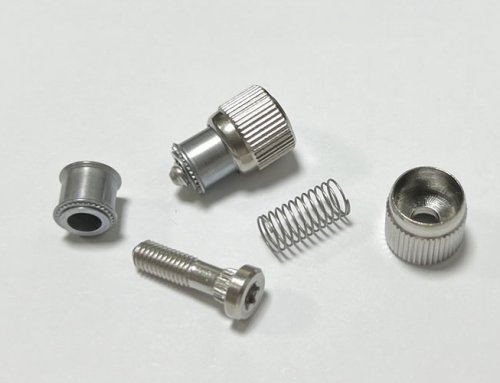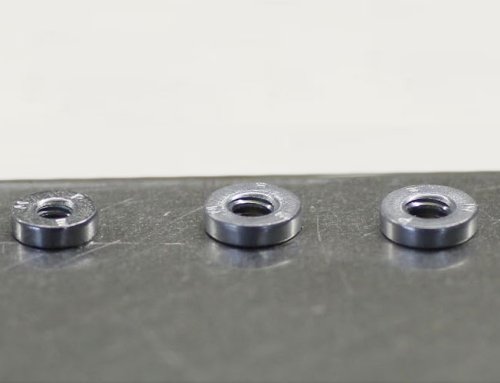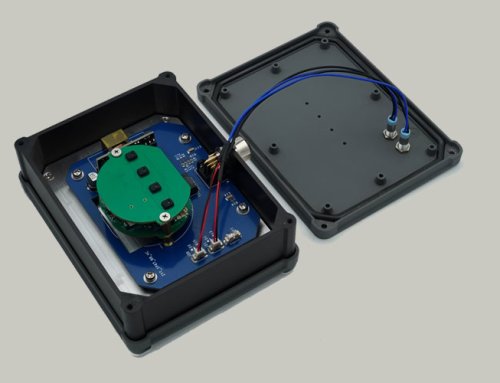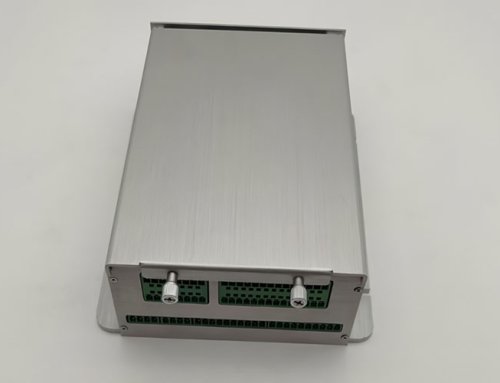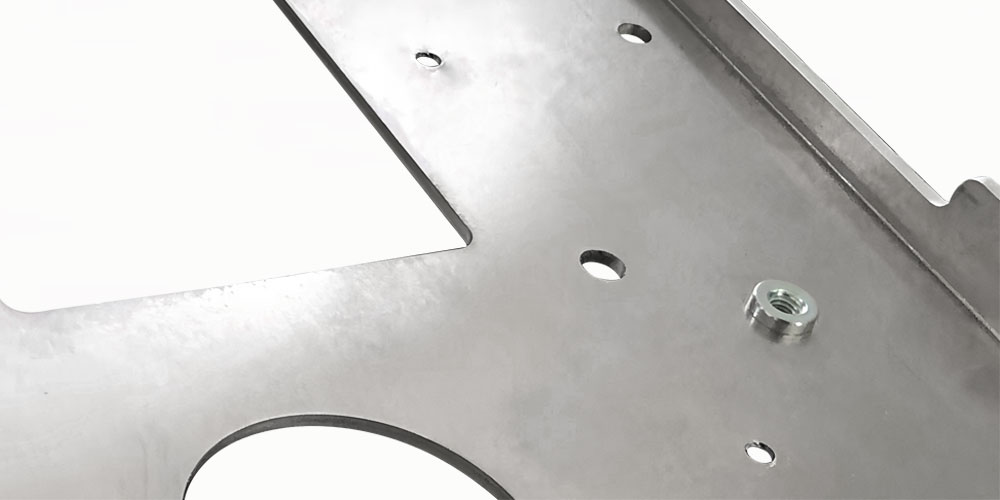
Specifications for self-clinching fasteners (including self-clinching screws, self-clinching nuts, and self-clinching studs) typically define “Maximum Hole Size in Attached Parts” – a critical dimension indicated by the red arrow in technical illustrations. This parameter represents the largest permissible diameter of the hole in the workpiece being fastened.
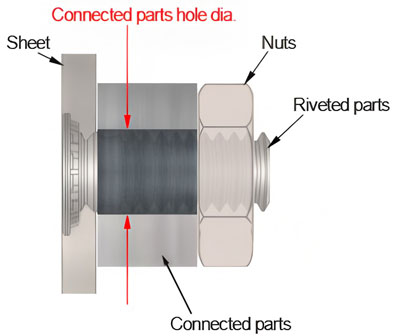
The technical significance of specifying the “maximum hole size of the connected parts” for self-clinching fasteners.
1, Functional purpose
Establishes dimensional limits to prevent fastener pull-out under load
2, Installation requirement
The rivet diameter must be slightly smaller than the hole diameter to achieve optimal clinching strength
3, Failure prevention
An oversized hole presents a risk. When the hole diameter equals or exceeds the rivet diameter, the fastening effect is reduced. This is because material deformation is decreased, weakening the clamping force.
Taking the FH-M6 self-riveting screw as an example:
The bolt head features an 8.2mm outer diameter. Engineers recommend a maximum connecting hole diameter of 6.6mm to maintain structural integrity. When adhering to these specifications, the mounting plate effectively functions as a load-distributing element, ensuring secure fastening. However, when hole dimensions equal or exceed the head diameter (8.2mm or larger), critical safety issues emerge. The entire tensile load transfers to the head’s riveted annular zone, creating high stress concentrations that dramatically elevate pullout risks. Lateral movement requirements further compound this hazard through uneven force distribution. Precision hole sizing remains paramount for connection reliability. Compliance with specified tolerances guarantees mechanical safety while non-conformance directly threatens structural stability. Engineering protocols must emphasize strict adherence to these dimensional controls to prevent catastrophic failures.
Design considerations for self-clinching fasteners
1, Proper hole sizing ensures permanent fastener retention through controlled material displacement.
2, Critical tolerance matching between fastener shank and hole diameter maintains structural integrity.
3, Deviations beyond specified maximums compromise the self-clinching mechanism’s mechanical advantage.
Would you like to learn more about self-clinch fasteners?
You can visit our official website www.thank-tech.com, where all self-clinching products are accompanied by parameter diagrams to guide you through the installation process.